Did you know that in 2026, the average person captures over 1,000 photos each year? With so many memories stored on your devices, it’s crucial to find a reliable solution to keep them safe. The right cloud option can help you organize, share, and protect these precious moments.
As your collection of images grows, you need a service that offers ample space, automatic backups, and user-friendly tools. This ensures that every cherished memory is preserved and easily accessible. Whether you’re a casual photographer or someone who captures every family gathering, having a dedicated space for your images is essential.
In this guide, we will explore the top choices available today. We’ve tested numerous providers to identify the best solutions tailored to your needs. By the end, you’ll know which option fits your lifestyle and budget, ensuring your memories are safe for years to come.
Key Takeaways
- Choosing a quality service helps keep your memories secure.
- Generous space and automatic backups are essential features.
- Organizational tools can enhance your photo management experience.
- Free options are available for budget-conscious families.
- Different plans cater to various needs and preferences.
Why Choosing the Right Cloud Storage for Family Photos Matters
In a world where we capture countless memories, selecting the right place to keep them is vital. Your family images represent irreplaceable moments—vacations, birthdays, and everyday joys. These memories deserve more protection than a single phone or hard drive can offer.
Photos pile up fast. Without a reliable backup, a lost or damaged device could mean losing years of precious memories forever. The right service ensures your family can access every photo from any device. Whether you’re at home on a laptop or sharing memories on a phone while traveling, accessibility is key.
However, not all options treat your images with the same care. Some services quietly compress file quality, which can be an issue if you shoot in RAW or want to print large-format images. You’ll want a service that keeps original quality intact and offers automatic backups.
A dedicated plan allows you to split costs with up to five or six members. This makes premium features surprisingly affordable on a per-person monthly basis. Security features like zero-knowledge encryption and two-factor authentication become critical when storing sensitive images.
The best cloud storage for family photos also provides flexible sharing controls. This way, you can keep personal files private while sharing vacation albums with the whole family. Investing time now in choosing the right option saves you from the headache of migrating scattered libraries later.
With the right plan in place, your family can relive memories in the highest quality. Knowing every file is safely replicated across multiple data centers brings peace of mind.

Understanding Your Photo Storage Needs Before You Choose
Determining the right amount of storage for your photos is key to keeping your memories safe. If you take a lot of pictures, you’ll want ample space. Initially, 5-10 GB of free storage may seem enough, but it fills up quickly. Over time, you might find yourself needing 1 TB or more to hold all your precious moments.
Our top recommendations provide between 500 GB and 12 TB, covering a wide range of needs. Before diving into options, take stock of how many images and videos your family has scattered across phones, cameras, and old hard drives.
A typical family can easily accumulate hundreds of gigabytes of images over a single year. Modern smartphones capture high-resolution pictures and 4K videos, adding to your collection. Free plans offering 5-15 GB might look generous at first, but they can fill up surprisingly fast once you start backing up your entire library.
Consider if you need space for RAW files from a mirrorless camera or if compressed JPEGs from your phone will suffice. Think about how many family members will need access. The best cloud options allow you to allocate different storage amounts to each user based on their needs.
Your budget is also important. Monthly plans offer flexibility, while lifetime plans from providers like pCloud and Internxt can deliver better long-term value. Evaluate how tech-savvy your family members are. A simple drag-and-drop interface with automatic backups works best for mixed experience levels.
Additionally, consider whether you need built-in photo editing tools or if you’re fine using separate apps. Think about your sharing habits: do you often share albums with extended family, or do you prefer to keep everything private within your immediate household?
Understanding these needs upfront helps you narrow down the best cloud storage option. This way, you can avoid paying for features your family won’t use.
| Storage Option | Free Storage | Paid Plans | Max Storage |
|---|---|---|---|
| pCloud | 10 GB | $4.99/month | 10 TB |
| Internxt | 2 GB | $5.00/month | 12 TB |
| Google Drive | 15 GB | $1.99/month | 2 TB |
| iCloud | 5 GB | $0.99/month | 2 TB |

Best Cloud Storage for Family Photos in 2026: Top Picks and Features
In today’s digital age, finding the best way to safeguard your treasured images is more important than ever. With countless options available, it’s essential to choose a service that fits your family’s needs. Here are some top picks for 2026, each with unique features to help you store and manage your memories effectively.
pCloud – Overall Best Cloud Storage for Family Photos
pCloud earns the top spot as the overall best cloud storage option. Its intuitive interface makes it easy to navigate, while the built-in media player ensures high-quality video playback. With a generous lifetime plan, you can avoid recurring monthly bills, making it a smart choice for families.
With pCloud’s family plan, you can invite up to five members. You can allocate storage starting at 100GB per user, ensuring everyone has enough space. Plus, fast transfers and file versioning protect your images for up to 30 days.
pCloud keeps your memories safe by storing five copies of each file on different servers across the US and Europe. Using TLS/SSL channel encryption, your data remains secure from loss.
Internxt – Fastest & Secure Cloud Storage for Photos
Internxt delivers the fastest transfer speeds among all cloud storage options. Its zero-knowledge encryption ensures that only you and your family can access your sensitive images. This makes it a great choice for privacy-conscious families.
Lifetime plans start at $380 for 1TB, and new users can enjoy 78% off for the first 12 months. This makes Internxt an incredibly budget-friendly cloud storage option.
NordLocker – Most Secure Cloud Storage for Pictures
NordLocker stands out as the most secure cloud storage for pictures. With end-to-end zero-knowledge encryption, only your family holds the decryption key. This service supports RAW and TIFF files, making it ideal for serious photographers.
NordLocker offers a 2TB plan for just $6.99 per month, with a 30-day money-back guarantee. Plus, 24/7 live chat support ensures help is always available.
IDrive – Best Photo Backup Solution
IDrive excels as the best photo backup solution. It offers file versioning for up to 30 versions, ensuring you can restore previous versions of your images. Password-protected sharing adds an extra layer of security for your files.
IDrive’s 5TB plan costs around $70 for the first year, making it one of the most affordable ways to back up extensive collections across multiple devices.
iCloud – Best Cloud Image Storage for iOS Families
iCloud remains the best cloud image storage for families fully invested in the Apple ecosystem. With seamless automatic uploads and storage plans reaching up to 12TB, it’s a solid choice for Apple users.
However, its limitations include no Android support and sharing restricted to other iCloud users. This makes it less versatile for mixed-device families.
Google Photos – Great Free Cloud Storage for Family Photos
Google Photos offers a compelling free cloud storage option with 15GB of space. It includes a built-in photo editor and AI-powered search, allowing you to find photos by typing keywords like “birthday” or “beach.”
However, storage is shared with Gmail and Google Drive, and media quality is reduced unless you pay for a Google One plan.
Degoo Cloud – Another Free Alternative with Generous Storage
Degoo Cloud provides a generous 20GB of free storage with AI-driven photo organization. While it has ads in the app and a three-device upload limit, it remains a viable option for families looking for free storage.
For those prioritizing privacy, Proton Drive offers 3TB of end-to-end encrypted storage with a family plan at $23.99 per month, based in Switzerland under strong privacy laws.
Dropbox Family and OneDrive round out the options with 2TB and 6TB plans, respectively. They integrate productivity tools like Office and Dropbox Paper for families who want more than just photo storage.
Each of these services offers a free personal plan or trial, so you can test the interface and features before committing your entire photo library.

Key Features to Consider in Cloud Storage for Family Photos
When it comes to preserving your cherished memories, knowing what features to look for in a photo storage solution is essential. There are several key aspects to consider that will help you make the best choice for your family’s needs.
Storage Capacity and Flexible Plans
Storage capacity should be your first consideration. Look for plans ranging from 500GB to 12TB. This range is ideal whether your family captures casual phone images or high-resolution RAW files from dedicated cameras. The best options provide flexible plans that grow with your family. Monthly subscriptions work well for short-term needs, while lifetime plans from providers like pCloud and Internxt offer exceptional long-term value.
Ease of Use and Multi-Device Accessibility
Ease of use matters immensely. Multiple family members of varying tech skill levels need to upload, browse, and share images without frustration. Ensure that your chosen service works seamlessly across Windows, macOS, Linux, Android, and iOS platforms. Web access can serve as a convenient fallback option.
Security and Privacy: Keeping Your Memories Safe
Security features like AES-256 encryption and zero-knowledge architecture protect your images from unauthorized access. Services like NordLocker and Internxt use end-to-end encryption, meaning only you hold the decryption key. This level of security ensures that not even the provider can access your files.
Sharing Controls and Family Plan Management
Effective sharing controls are crucial. Look for options that allow you to create password-protected links, set expiration dates, and separate shared folders from personal files. Family plan management tools enable the account admin to allocate different storage amounts per user. This way, you can give more space to the photography enthusiast in your family and less to those who need minimal storage.
Backup Automation and Syncing Across Devices
Backup automation is essential. The best cloud services automatically upload new images from every family member’s phone the moment they’re taken. Syncing across devices ensures that photos uploaded from one device appear instantly on all others, keeping your family’s library consistent and up to date.
Photo Organization and Editing Tools
Photo organization tools can make finding specific memories quick and intuitive. Look for features like AI-powered search in Google Photos or timeline views in pCloud. Built-in photo editors, while not essential, add convenience. Google Photos offers robust editing tools, while pCloud includes a photo gallery with basic management features.
By considering these features, you can ensure your family’s experience with cloud storage is secure, simple, and enjoyable for everyone involved.

Managing Your Family Photos Across Multiple Cloud Services
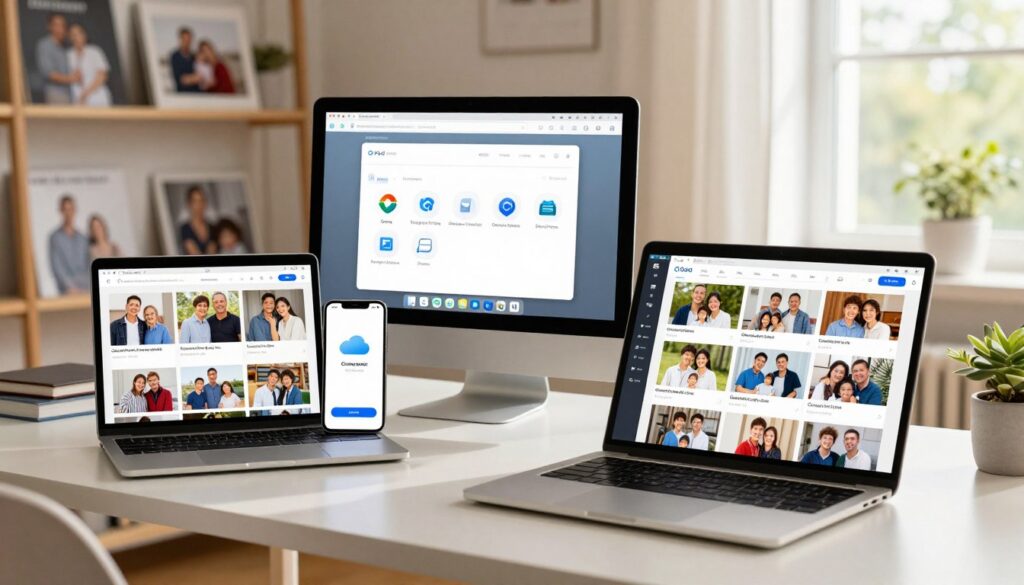
Managing your cherished memories can become a daunting task when they’re scattered across multiple services. Many families find their photos dispersed across various platforms, such as Google Photos from Android days, iCloud from old iPhones, and Dropbox from past projects. This can complicate the management of your memories.
Juggling several cloud apps to find a specific photo wastes time and creates frustration, especially when you’re trying to share memories quickly with family members. Fortunately, tools like CloudMounter can simplify multi-cloud management by mounting all your accounts as local drives on your computer. This means they appear right in Finder or File Explorer.
With a unified cloud management tool, you can browse photos across Google Drive, Dropbox, OneDrive, and pCloud in one place without opening multiple apps or browser tabs. Dragging and dropping files between different services becomes as simple as moving files between folders on your desktop, making reorganization effortless.
CloudMounter doesn’t download entire photo libraries to your laptop just for browsing—it streams previews on demand. This feature is crucial when dealing with massive collections. Consolidating your family photos into a single primary service while using others for secondary backups provides both convenience and redundancy.
Regularly auditing your scattered storage helps you identify duplicates, free up space, and ensure every important memory is backed up to your primary plan. Setting aside time once a year to consolidate photos from various services prevents chaos as your collection grows.
The goal is to reach a point where every family member knows exactly where photos live, how to access them, and that they’re safely backed up across reliable options. By managing your family’s photo collection effectively, you can ensure that those precious memories remain accessible and secure.
Tips to Keep Your Family Memories Secure and Easily Accessible
Keeping your family memories safe and accessible is crucial in today’s digital world. Here are some practical tips to help you manage your photos effectively.
Always enable two-factor authentication on your cloud storage account. This adds an extra layer of security beyond just a password. This simple step prevents most unauthorized access attempts.
Use strong, unique passwords for each service. Consider a family password manager to keep credentials secure yet accessible to trusted members.
Set up automatic phone backups immediately after choosing your cloud option. Services like pCloud, Google Photos, and iCloud can upload every new photo the moment it’s taken.
Regularly review your sharing settings. Ensure old shared links are expired and that private images aren’t accidentally visible to unintended people.
Implement the 3-2-1 backup strategy: keep three copies of your family memories, on two different media types, with at least one copy stored off-site in the cloud.
Take advantage of file versioning features. Services like pCloud and IDrive let you recover previous versions of photos for up to 30 days, protecting against accidental deletions.
Organize your photo library with consistent folder naming conventions. Use labels like the year and event to make browsing and searching intuitive for every family member.
Periodically audit your cloud space. Remove duplicate photos, blurry shots, and unwanted screenshots that waste valuable storage capacity.
Educate every family member on basic cloud hygiene. Teach them how to upload photos, check backup status, and avoid deleting shared files that others still need.
Consider keeping a secondary backup with a different provider for your most irreplaceable images. Diversifying reduces risk if one service experiences an outage.
Download and archive your most important photos locally at least once a year. Store them on an external drive kept in a safe location.
Use built-in media players in services like pCloud to enjoy family videos in their highest quality without needing to download large files first.
Take advantage of AI-powered search in Google Photos and organization tools in other apps to quickly locate specific memories without endless scrolling.
Review your cloud storage plan annually. Ensure it still meets your family’s growing needs. Upgrading storage before you run out prevents interrupted backups.
Remember that free options like Google Photos and Degoo are great starting points. However, investing in a paid plan ensures original quality preservation and better security.
Conclusion
In an age where memories are captured at the click of a button, safeguarding them is essential. After exploring various options, it’s clear that pCloud stands out as the best cloud storage solution. Its combination of ease of use, fast transfers, and affordable lifetime plans makes it a top choice.
For those prioritizing security, NordLocker and Internxt offer robust encryption features. If you’re part of the Apple ecosystem, iCloud provides seamless integration, though it may not suit mixed-device families.
Budget-conscious users can start with Google Photos or Degoo Cloud, both offering free plans. No matter which option you choose, remember to back up your precious memories today. Implement the tips from this guide to keep your files organized and accessible for years to come.
Your family photos tell the story of your lives together—investing in the right service ensures those stories remain safe and shareable.